Reducing the Risk
“We are deeply thankful for the support in addressing this issue, as our priority is to keep our communities safe from contamination and ensure a healthier future for our people – Mr. Chouman, Head of Municipality, Serraaine, Bekaa Valley on September 2nd, 2025.
Context
In the Bekaa Valley, the aftermath of the 2024 war, which displaced over 900,000 people and caused widespread damage to essential infrastructure, has left thousands of families without safe water and proper waste management.
With support from Radiohjälpen and in partnership with LM International, Medair is helping affected communities in the Bekaa Valley, through targeted water and sanitation interventions. These efforts aim to restore and improve water network infrastructure, ensure access to safe water, and reduce risks linked to wastewater.


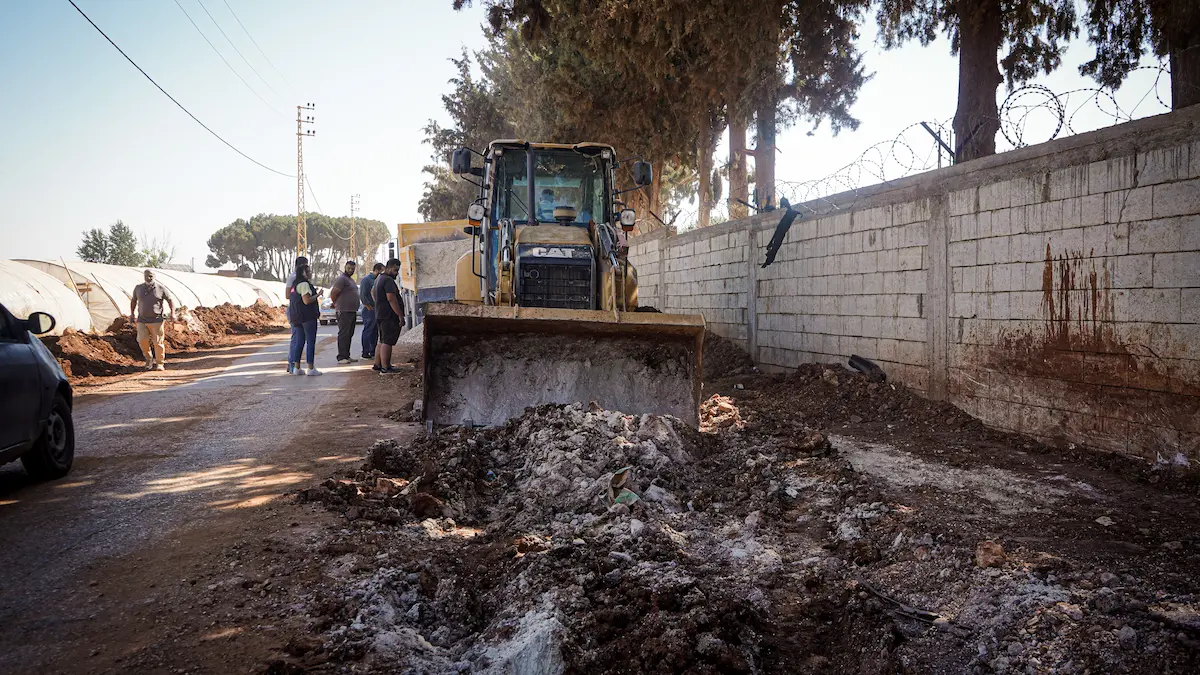
The town of Serraaine, home to around 35,000 people in North Bekaa, was heavily impacted by the conflict. Medair has supported the local Primary Healthcare Centre (PHCC) since 2022, which serves as the only healthcare facility for miles around. Following a notice from the municipality about a blockage in the main sewer system, Medair’s team quickly mobilized to assess the site. Untreated sewage had begun pooling underground, posing a threat to nearby water sources, agricultural land, and affected communities who rely on them.
After a thorough assessment, the team discovered a broken and severely clogged concrete pipe as the source of the problem. Replacing it was not straightforward. Finding a replacement pipe with the exact dimensions was challenging. Any change in size would have required replacing the entire underground network—a costly and complex task. Despite constraints, Medair’s team secured a suitable replacement, which is now installed to restore full functionality to the main sewer system.
Why this matters?
Untreated sewage poses a serious threat to agriculture and the environment, as it can leak into surrounding areas and contaminate nearby water sources and utilities. Contaminated water can carry harmful microbes, significantly increasing the risk of waterborne diseases such as cholera, and hepatitis A.

“This intervention is absolutely crucial for our community,” said Mr. Chouman, the Head of the Municipality. “Untreated sewage threatens our nearby water sources and could easily lead to outbreaks of dangerous diseases. We are deeply thankful for the support in addressing this issue, as our priority is to keep our communities safe from contamination and ensure a healthier future for our people.”
With support from Radiohjälpen and in partnership with LM International, Medair’s intervention goes beyond repairing the damaged sewer pipe. To further safeguard the health and dignity of the community, the team will be distributing water tanks to households to ensure safe and sufficient water storage—especially in underserved areas where the water network is unreliable.

In coordination with the Bekaa Water Establishment, Medair is also repairing and upgrading the water chlorination system to guarantee continuous access to clean water. In addition, the team is working to restore and improve the water network itself, ensuring that affected communities have reliable access to clean water.
To ensure the effectiveness of these measures, Medair’s field teams are implementing a water quality monitoring plan. Weekly tests for free chlorine levels will verify that water supplied through the network and stored in household tanks remains safe for use. Through these comprehensive interventions, Medair is reducing waterborne health risks, protecting vital water resources, and strengthening the resilience of families and children in the Bekaa Valley—helping build a safer, healthier future for the community.
Medair's work in Lebanon is possible with funding from Radiohjalpen and LM International, The German Federal Foreign Office (AA), Swiss Development Cooperation through Interaction-CH, Lebanon Humanitarian Hub (LHF), United Nations High Commissioner for Refugees (UNHCR), USAID and the generous support of the American People and generous private donors.
This content was produced with resources gathered by Medair field and headquarters staff. The views expressed herein are those solely of Medair and should not be taken, in any way, to reflect the official opinion of any other organisation.
.webp)
.webp)
.webp)