A place to start again
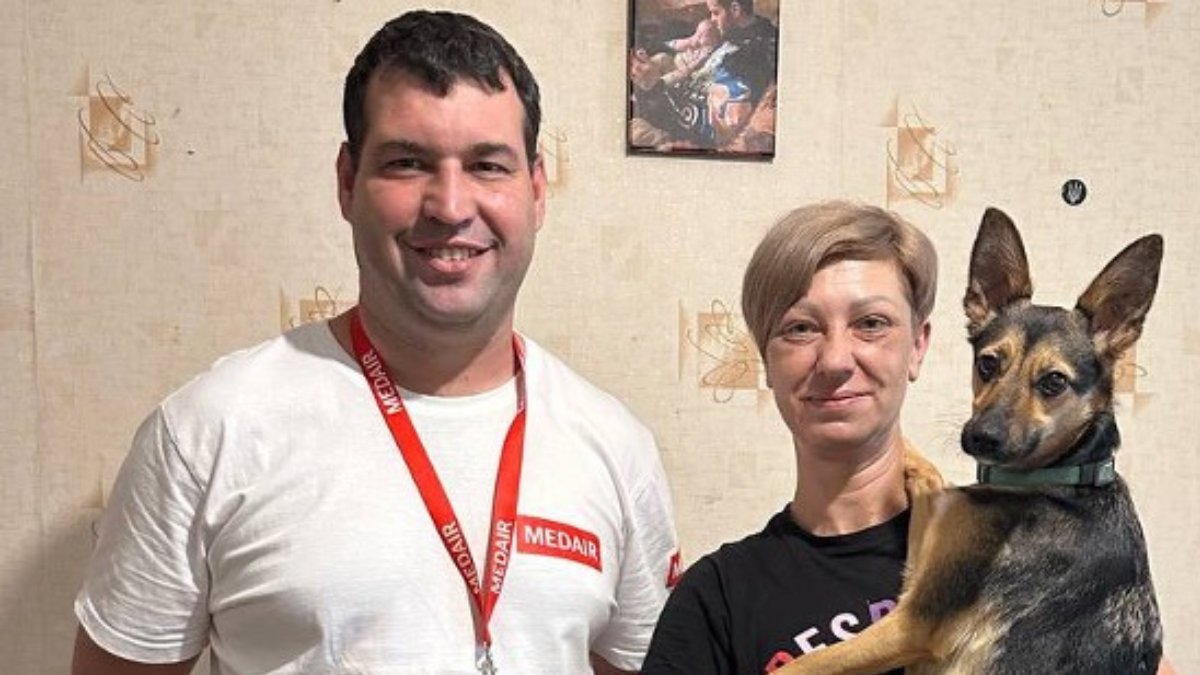
When fighting forced Marina to leave her home in Ukraine’s Donetsk region for the second time, reaching safety was only the beginning. With rents beyond her reach and landlords reluctant to accept her and her dog, finding somewhere to live became another struggle. Through Medair’s Alternative Housing Solutions programme, funded by the European Union, Marina found more than an apartment. She found the stability to begin rebuilding her life.
For years, Marina had built her life in a city in the Donetsk region. She worked at the railway station and had a home and community there.
Then the war changed everything.
As fighting intensified in 2022, Marina was forced to leave. She evacuated to another city in a safer area, where she tried to start again. She found work at a mine and adapted as best she could to a life she had never planned.
But the safety did not last.
By the end of 2025, the fighting was once again approaching the area where Marina was living. As the security situation deteriorated, she had to make the painful decision to leave home for a second time.
Reaching safety – but having nowhere to call home
Marina first arrived at a transit centre, a temporary facility where displaced people can find short-term shelter and essential support.
For people evacuating from frontline communities, reaching a safer location can bring immediate relief. But evacuation does not solve everything. The next question can be just as daunting: Where do you go from here?
Marina is one of around 3.45 million people who remain or are newly internally displaced inside Ukraine. Finding somewhere to rebuild their lives is becoming increasingly difficult: around 14% of the country’s housing stock has been damaged or destroyed by the war, affecting over three million households. Marina’s experience of being uprooted more than once is far from unusual. The UN estimate that 40% of internally displaced people in Ukraine have experienced multiple displacements as repeated attacks force families to move again in search of safety. Temporary transit and collective centres provide an essential safety net, but they are not long-term homes.
This is where Medair’s Alternative Housing Solutions programme can help.
Medair works individually with displaced households to help them move towards safe, dignified and more independent accommodation. Depending on their circumstances, this can include searching for housing, communicating with landlords, addressing documentation barriers, referrals to other services and temporary rental assistance. For newly displaced people who are able to earn an income, Medair can provide housing support for up to six months, giving them a period of stability without the immediate pressure of paying rent. This allows them to focus on finding employment, establishing a regular income and ultimately becoming independent again.
For Marina, Medair’s team organised her onward relocation from the transit centre and supported her search for somewhere she could settle.
A place for Marina – and her dog
High rental prices and the need for a deposit presented one major obstacle. Finding a landlord willing to accept Marina together with her dog made the search even harder.
Eventually, Marina decided that a city in Dnipro oblast offered her the best opportunity to start again. With Medair’s support, she found affordable accommodation where she and her dog could live together.
For someone who has been displaced repeatedly, an apartment represents far more than four walls and a roof.
It means privacy after the uncertainty of evacuation. A place for personal belongings. A neighbourhood in which to look for work. And, perhaps most importantly, the opportunity to begin making decisions about the future again.
Medair’s support is designed as a temporary bridge towards greater independence. Rental assistance can be provided for up to six months depending on vulnerability and local conditions, while caseworkers help households overcome barriers that might otherwise keep them in temporary or insecure accommodation.

A safe home can be the beginning of recovery
When Medair staff later visited Marina, she described improvements in her mental and emotional wellbeing. She felt more stable and confident about the future.
There was another important development: Marina had found a job and was completing her probation period – a major step towards supporting herself independently.
She hopes her new accommodation will become a safe and comfortable home for a long time and allow her to gradually restore stability to her life.
Her experience shows why shelter assistance is about more than buildings. Safe housing can provide the foundation from which people begin recovering from displacement: finding employment, accessing services, rebuilding routines and regaining a sense of control over their lives.
That principle is central to Medair’s broader response in eastern Ukraine.
With funding from the European Union, Medair is providing integrated Shelter, water, sanitation and winterisation assistance across Chernihiv, Sumy, Kharkiv, Donetsk, Dnipro and Zaporizhzhia regions. Alongside Alternative Housing Solutions, activities include repairing conflict-damaged homes and collective shelters, improving insulation, rehabilitating water and heating infrastructure, and providing winter support to vulnerable households.
Medair also links this work with mental health and psychosocial support and health services delivered through complementary programmes, helping people access support beyond their immediate shelter needs.
For Marina, the future remains uncertain. The home she left behind is still in a region deeply affected by war.
But after being uprooted twice, she once again has somewhere from which to move forward.
And sometimes recovery begins with something as simple – and as important – as having a place to call home.
Medair Alternative Housing Solutions project is funded by the European Union and generous private donors.
This content was produced with resources gathered by Medair field and headquarters staff. The views expressed herein are those solely of Medair and should not be taken, in any way, to reflect the official opinion of any other organisation.
Featured picture: Marina with a Medair Case Management Officer Ivan and her dog in her new home. With Medair’s support, Marina found safe and affordable accommodation after being forced to flee her home for the second time. © Medair