It was like being reborn

When Alain walked through the doors of the Ebola Treatment Centre (ETC) in Katwa, in eastern Democratic Republic of the Congo, he was convinced he would never see his family again. In his community, rumours about Ebola and treatment centres fueled fear. Yet, a few weeks later, he emerged cured. Even more remarkably, his story convinced five members of his family to seek treatment in time, thus helping to save their lives.
A misunderstood illness
It all began when Alain's younger brother fell ill.
"When my brother got sick, we thought he had been poisoned. He had diarrhoea, severe stomach pains, and he was getting weaker every day. We tried to treat him at home with medicine and traditional remedies because we didn't think of Ebola at all. When someone is sick, Ebola isn't the first thing that comes to mind in our community; it's a term that evokes death and conspiracy – that's not good."
Yet the young man's condition continued to deteriorate. After lengthy family discussions, he was transferred to Katwa General Hospital. A week later, the diagnosis came: he had Ebola. Sadly, by the time his result came back, he had already died.
"Losing my brother without really understanding what was happening to him was one of the most painful moments of my life. When the results came back after his death, we were all in shock."
When Alain fell sick
A few days after his brother's death, Alain began to experience worrying symptoms himself.
"First fatigue, then fever. I tried to convince myself it was nothing. I took medication at home and tried to treat myself. But the illness progressed faster than I could have hoped."
Aware that he had been in close contact with his brother, he feared the worst.
"I knew I had been in contact with my brother. Part of me was already afraid I had Ebola, but I refused to believe it."
Finally, Alain called an ambulance himself to go to the Ebola Treatment Centre (ETC) in Katwa supported by Medair. A few days later, his test results confirmed his fears: he was positive for Ebola.

“I thought I was going to the Ebola Treatment Center to die”
For Alain, the diagnosis was devastating. Yet, something else terrified him almost as much as the illness itself: the rumours.
“Back home, many people said that the the Ebola Treatment Centre (ETC) in Katwa was a place where they took sick people to be killed. Some even claimed that no one came back alive.”
“I’d heard that there was a hammer used at night to kill patients. There were also rumours that the food served at the centre was poisoned. With all these stories, I arrived at the the Ebola Treatment Centre (ETC) in Katwa convinced that my last days had come.”
This fear was so strong that he refused to eat during his first few days of treatment.
“They brought me food, but I hardly touched it. I was convinced they wanted to poison me. Now, it seems unbelievable, but at the time, I truly believed it. The virus was attacking my body, but the rumours were attacking my mind.”
Then came a decisive moment.
“One day, I said to myself: either I continue to believe what people on the outside say, or I give a chance to those who are trying to save me. That’s the day everything changed.”
Inside the PPE: human beings
Little by little, Alain observed the healthcare workers around him and discovered a reality very different from the one he had imagined.
“Behind the masks and protective equipment, I recognised women and men who were risking their lives to save ours. Contrary to what I had imagined, I didn’t see dangerous or malicious people, but dedicated professionals.”
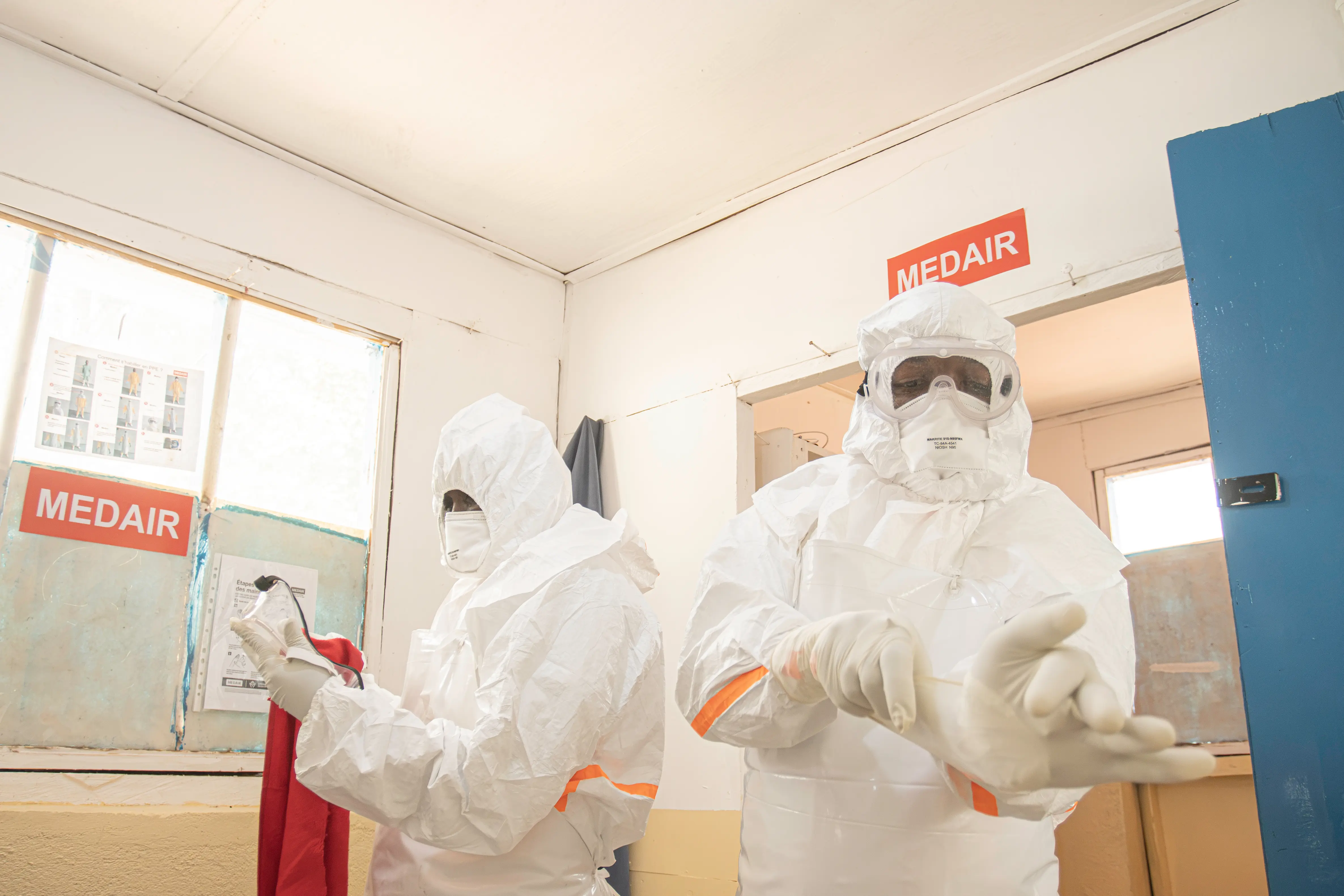
Gradually, a relationship of trust was built.
“The nurses took the time to talk to me, reassure me, and answer my questions. Little by little, they became my friends. Their support gave me back the strength to eat, to follow the treatments, and to believe in my recovery again.”
A new life
As the days went by, Alain’s symptoms lessened and his strength returned. Then came the news he had almost given up hope for.
“The day I was told I was cured, I felt something indescribable. I felt like I was being reborn.”
This recovery profoundly changed his perspective on the disease and the treatment centre.
“I realised that everything I had heard about the Ebola Treatment Centre was false. The reality was completely different from the rumours.”


From survivor to advocate
After his recovery, Alain discovered that several members of his family had also been exposed to the virus. Like him, they initially hesitated to go to the treatment centre.
So he decided to share his experience.
“I told them: look at me. I’m alive. If this centre wanted to kill people, I wouldn’t be standing here in front of you today. I recounted what I had seen, the quality of care, the staff’s attentiveness, and the treatments I received. I wanted to replace fear with the truth.”
Thanks to his testimony, five members of his family agreed to be treated. All of them survived.
“When I saw my family members leave, cured in turn, I understood that my testimony had saved lives. It’s a source of pride that will always stay with me.”
They are among the more than 40 people who have recovered and been discharged to date from the Katwa Ebola treatment centre.
Today, Alain continues his awareness campaign.
“Rumours can kill as surely as a disease. Some people die because they arrive at treatment centres too late due to fear.”
“If you are sick, seek treatment quickly. I survived Ebola because I finally learned to trust the healthcare professionals who wanted to save me.”
“I couldn’t save my brother. But thanks to his story,i helped five family members seek treatment early. It is his memory that gives me the strength to speak out today.”
In a region deeply scarred by Ebola, Alain’s journey serves as a reminder of a crucial truth: sometimes, the first step toward healing is overcoming fear.
Medair's Ebola Response work in the DR Congo is made possible through funding from the US State Department, the DRC Humanitarian Fund, the Swiss Agency for Development and Cooperation (SDC), the European Directorate-General for Civil Protection and Humanitarian Aid Operations (DG ECHO), the Swiss Solidarity Foundation and generous private donors.
This content was produced with resources gathered by Medair’s programme and headquarters staff. The views expressed herein are those solely of Medair and should not be taken, in any way, to reflect the official opinion of any other organisation.
.webp)
.webp)
%20(1).webp)